|
|
|||||||||
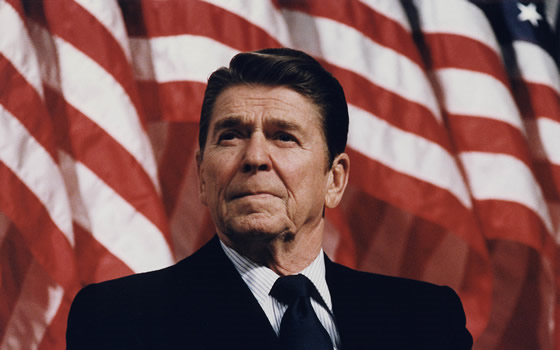
40th President of the United States of America RONALD WILSON REAGAN February 6, 1911 - June 5, 2004
“Whatever else history may say about me when I'm gone, I hope it will record that I appealed to your best hopes, not your worst fears; to your confidence rather than your doubts. My dream is that you will travel the road ahead with liberty's lamp guiding your steps and opportunity's arm steadying your way.”
NOTICE: By visiting any or all pages of this website, you indicate that you have read and understand and consent to the guidelines and disclaimer and agree to always abide by them.OCTOBER 5-11, 2026PLAYER ON TEXAS LONGHORNS FOOTBALL TEAM DOES A DISGUSTING CELEBRATION GESTURE.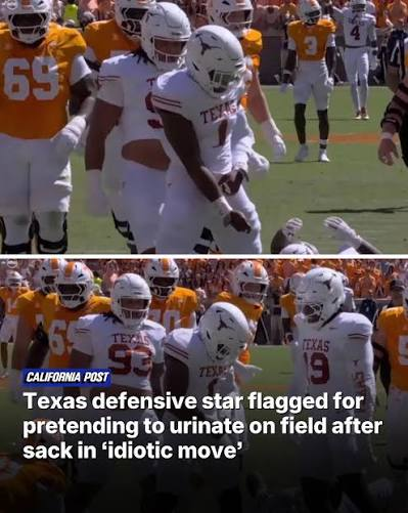
Image Credit, Google Images
Texas defensive end Colin Simmons pictured above received an unsportsmanlike conduct penalty for pretending to urinate on the field after a sack against Tennessee on September 26, 2026, but he was not ejected from the game. Under college football rulebook guidelines, a simulation of an offensive or vulgar gesture is penalized as unsportsmanlike conduct rather than an automatic disqualifying flag, unless a player makes direct physical contact with an official or performs multiple flagrant acts that escalate to a second unsportsmanlike penalty (which results in an ejection). Simmons briefly exited the field to speak with head coach Steve Sarkisian before returning to finish his record-tying five-sack performance in the 20-17 victory. During the game with the Tennessee Volunteers, Simmons celebrated a stop by mimicking urinating on an opponent. The official announced an unsportsmanlike conduct penalty "for simulating using the restroom." ABC's broadcast booth was even less charitable. Kirk Herbstreit called it "just an absolute idiotic move by Colin Simmons doing that," while Chris Fowler added, "Yeah, it's idiotic, and it doesn't get much more vulgar, either.” Simmons appeared stunned that officials objected to the gesture. COMMENTARY & MY OPINIONSo, what did Texas coach Steve Sarkisian say About Colin Simmons' celebration? He told reporters after the game that they took Simmons out briefly following the celebration before putting him back in. Sarkisian made it clear that Simmons made a mistake but noted it is a learning lesson for both him and the team. "We took him out, we addressed it, and put him back in," Sarkisian continued. "I mean, at that point, I'm not going to give the guy the death penalty over an unsportsmanlike conduct penalty. My opinion? NOT GOOD ENOUGH SARKISIAN! Colin should be suspended for 2-3 games. That did not happen because it is ALL about winning. Simmons apologized publicly after the game, admitting he got too caught up in the moment. Too late, the toothpaste is already out of the tube. It looked to me during his apology that at times he had a smirk on his face. Just another entitled football player that thinks he can get away with almost anything. Texas Longhorns Colin Simmons has an estimated NIL Valuation of approximately $1.5 million to $2.5 million. His current NIL deals are, Dodge Ram Trucks: Signed a prominent NIL deal featuring a social media commercial released in September 2026 and Nike: Inked a major NIL agreement as part of Nike's expanded roster and elite college athlete initiative supporting top football talent. If I was the head of Dodge and Nike, I would have written into the his NIL contract that the contract will be null and void and can be withdrawn at any time if he does any of the following, criminal behavior, vulgar or disgusting displays on the game field, criminal drug actions, etc. Simmons may have apologized but I doubt he really means it. He will still be collecting his NIL $$$$$$.
UNLESS NOTED ABOVE, LOOK FOR A NEW POST ON MONDAY.Copyright © 2026, Lance A. Carter and L. Carter’s Corner. All Rights Reserved
|
|||||||||